 Dawn Reading
One Tear, One Sip, No Spoon: A Month of CoQ10 Pouches in the Truck
Codeage's Wonder Heart comes as thirty raspberry pouches with 100 mg of CoQ10 in each, nothing to measure. I read its panel, its refund terms and the studies behind it from the driver's seat.

This is a paid advertisement. Sponsored by Codeage LLC.

Earl Whitmore is a pen name, and the pickup, the creek, Hal and the dog in these pages are pieced together from mornings our writers know well.
What the page says about the pouch comes from the seller's listing, its ingredient panel, its refund and shipping terms and the published studies, all read in September 2026.
Most of my mornings start in the truck, not at the kitchen table.
By ten past six I'm parked at the gravel pull-off on Cedar Creek Road, with a thermos of coffee and a brown dog named Tucker in the passenger seat.
The feed store doesn't open until seven.
So for fifty minutes it's me, the dog, the cedars along the bank and the sound of the water going over the rocks.

Some mornings Hal pulls in beside me in his old blue Ford.
We've known each other since the eighth grade, and we mostly talk about the weather, the price of hay and whose grandson throws harder.
One morning in August he leaned out of his window and held up something small and white.
"My daughter orders these by the box," he said.
"You tear the top off and drink it," he went on.
"Nothing to measure."
It was a little pouch, a bit taller than the ketchup packets at the diner.
Across the front it said "Wonder Heart," and under that it said CoQ10.
Hal isn't a reading man, and he knows I am.
"Tell me if it's worth forty dollars a box," he said, and he drove off to his shift at the co-op.
Nothing to measure. That was the part that stayed with me all the way to the feed store.
Because if you're past sixty and you've decided to look after your heart and circulation, you've probably noticed how much of it comes with measuring.
Steps on a phone, milligrams on a label, scoops and spoons and softgels in a row.
This page is what I found when I read that pouch the way I read a feed tag: every line, and then the small print.
It isn't a verdict, and it isn't medical advice.
It's one man's reading of a box of thirty pouches, done mostly from a parked truck.
By the end, you'll know what's in the pouch, what the studies behind it measured and what they didn't, and whether the no-measuring part is worth paying for.
Ten Past Six at the Pull-Off on Cedar Creek Road
Let me tell you a little more about those fifty minutes, because they explain why the pouch caught my eye.
They're the only part of my day that belongs to nobody else.
I pour the first cup from the thermos into its steel lid and set it on the dash.
Tucker puts his chin on the window ledge and watches the creek for anything that moves.

Then I do the one thing I've done nearly every morning since I retired from the county road crew.
I walk the creek trail, down to the old iron bridge and back, about a mile and a half.
Why the walk? Because it's the one habit I've kept that I know is good for the heart and circulation.
The federal activity guidelines ask adults for 150 to 300 minutes a week of moderate activity like brisk walking, and my creek loop gets me a good share of that. [1]
And the rest? The rest I've tried, and most of it didn't last.
Not because it was wrong, but because it lived in the wrong place.
My wife bought me a set of measuring spoons for the salt, and they're still in the drawer.
My son put a step counter on my phone, and I stopped looking at it the week he went home.
My brother-in-law swears by a powder he stirs into water with a little scoop.
I tried it for nine days, and on the tenth I was halfway to the creek before I remembered it was sitting on the kitchen counter.
The habits that last are the ones that ride along with a habit you already have.

That's not a complaint about spoons or scoops.
It's just how a morning works when it happens in a truck instead of a kitchen.
Is that you, too? Maybe your mornings are on a tractor seat, or in a shop, or on a golf cart at the ninth hole.
Wherever yours are, you know the feeling of a good idea that stays home while you go out.
So when Hal said "nothing to measure," he wasn't selling me anything.
He was describing the one thing my morning had room for.
But a small pouch that's easy to carry is still a small pouch that costs money.
And before anything goes in the truck, I like to know what it is.
What CoQ10 Is, Before Anybody Sells You Any
So what is CoQ10? The long name is coenzyme Q10, and it's a substance your body makes on its own.
The National Center for Complementary and Integrative Health describes it as already present in the human body, with the highest levels in the heart and a few other organs. [2]
It's sold in the United States as a dietary supplement, and you've probably walked past a shelf of it without looking twice. [2]
The name sounds like a part number for a carburetor.
What does it do in there? It helps the cell turn food into usable power.
Inside the tiny power plants of each cell, the mitochondria, CoQ10 is needed to turn the energy in carbohydrates and fats into ATP, the form of energy cells run on. [3] [4]
Think of ATP as the diesel the cell's machinery burns.
CoQ10 is one of the hands on the loading dock that keeps that fuel moving.
It also sits in other membranes of the cell, where its reduced form acts as an antioxidant and helps recycle vitamins E and C. [4]
That's a lot of work for something most of us have never thought about.
Why do people connect it with the heart? Because the heart is one of the places it's most concentrated.
In human tissue samples, the heart was among the three tissues with the highest levels of CoQ10, 60 to 110 micrograms per gram. [5]
That makes sense when you think about it.
The heart never clocks out, and a muscle that works every second of your life runs on a steady supply of cellular fuel.
The heart is one of the busiest places CoQ10 works. That's a fact about the body, not a promise about a pouch.
Does the body make less of it with age? In a number of tissues, the level falls gradually as the years go by. [3]
That's the part the advertising likes to lead with.
Here's the part it usually leaves out.
The same source says it's unclear whether that fall amounts to a shortage, and a shortage has not been described in the general population. [3]
In other words, a smaller number at seventy than at twenty-five is not the same as running low.
I'd rather you hear that from me now than find it in the small print later.
Your body still makes its own CoQ10, every day, at any age.
Then why take any? Some men want a little more of something the heart uses a lot of, on the chance it helps the ordinary work of cellular energy.
That's a reasonable thing to be curious about, as long as you know which parts are studied and which parts are hope.
And the first thing to know is how much you're already getting.
Because it turns out the dinner table brings a lot less than you'd guess.
Eight Pounds of Peanuts, or One Small Pouch
Before I spend money on a nutrient, I like to know how much I'm already getting from food.
With CoQ10, the answer is not much, and it depends a lot on what you eat.
How much comes from food? The average diet supplies about 3 to 6 milligrams of CoQ10 a day. [6]
Most of it comes from meat, poultry and fish, with some from cooking oils like soybean and canola, and from nuts and seeds. [6] [7]
Here's where it gets interesting for a man who keeps a bag of roasted peanuts on the dashboard.
An ounce of roasted peanuts holds about 0.8 milligrams of CoQ10. [6]
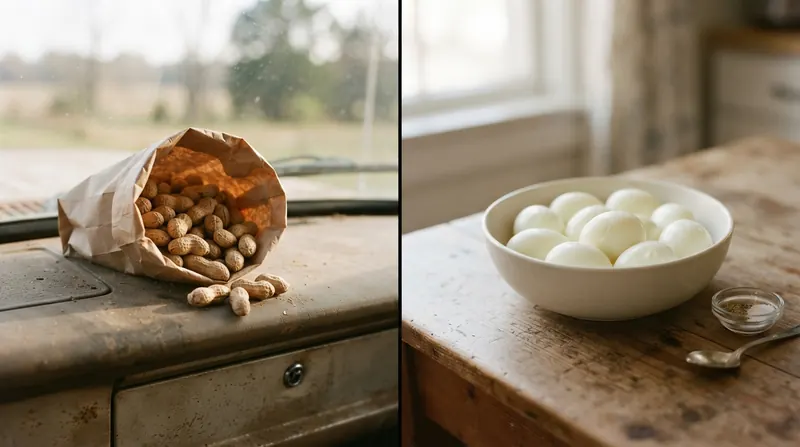
The pouch Hal handed me holds 100 milligrams.
To match that with peanuts, you'd have to eat about 125 ounces of them, which is close to eight pounds in a single day.
Boiled eggs are worse.
A boiled egg carries about 0.1 milligrams, so you'd need about a thousand of them. [6]
Eight pounds of peanuts, or a thousand boiled eggs. That's how far 100 milligrams sits from the dinner table.
Meat does better, but not by enough to matter here.
Three ounces of fried beef holds about 2.6 milligrams, and three ounces of marinated herring about 2.3. [6]
Even the vegetables I like come in low.
Half a cup of boiled broccoli gives about 0.5 milligrams, and a medium orange about 0.3. [6]
Does cooking change it? It does, and this one surprised me.
In a Danish study of food and diet, frying destroyed 14 to 32 percent of the CoQ10 in the food, while boiling caused no detectable loss. [8]

So the sausage at the diner, fried on the flat-top, has already lost some of its CoQ10 by the time it reaches you.
That's no reason to give up the diner, but it's a good reason not to count the sausage as a supplement.
Is food a bad source, then? Not at all.
Food is estimated to provide about a quarter of the CoQ10 in your blood, and it comes with everything else a good plate carries. [9]
Supplements for adults usually provide 30 to 100 milligrams a day. [6]
So the pouch sits at the top of the usual range, many times what a day's meals bring.
A day of good food brings a few milligrams. A supplement brings dozens of them.
That's the first honest line about any CoQ10 product, whether it comes as a liquid, a softgel or a pouch.
The amount is far beyond a plate, and whether that extra amount does anything you'd notice is a separate question, which we'll come to.
The Trouble With Something That Won't Mix With Water
Now here's the part of CoQ10 that most people never hear about.
It doesn't like water.

What does that mean for you? CoQ10 is fat-soluble, so it's best absorbed with fat in a meal. [9]
Take it with plain water on an empty stomach and it has a harder trip ahead of it.
How much of it actually gets in? Less than you'd hope.
Less than 5 percent of a dose taken by mouth is thought to reach the circulation. [9]
Read that twice, because it changes how you look at every bottle and box on the shelf.
The number on the front is what goes into your mouth, not what reaches your blood.
Why so little? Because of the trip it has to take.
Once swallowed, CoQ10 travels through the small intestine, where bile helps package it with other fat-soluble nutrients, and then through the lymph to the blood. [10]
That trip typically takes 5 to 8 hours. [10]
It's more like a slow creek in August than a hose.

Blood levels usually peak about six hours after a dose, and take about 33 hours to fall by half. [10]
So a steady level takes one to two weeks of daily use to build. [10]
Five to eight hours to arrive, and a week or two to settle in. It's a slow nutrient.
Does taking more help? Up to a point.
Blood CoQ10 rises gradually with larger doses, but the share absorbed falls as the dose grows. [11]
That's why doses above 100 milligrams a day are usually split into two or three. [9]
The pouch holds exactly 100, so one pouch a day stays right at that line.
And people differ? A lot.
How well a given formulation is absorbed varies widely from one person to another. [10]
I should tell you who wrote that review.
Its two authors work for a company that makes CoQ10 supplements, and they say so in the paper.
The hard part of CoQ10 isn't swallowing it. It's getting it from your stomach to your blood.
So the real question for any CoQ10 product isn't just "how much?"
It's "how does it get in?", and that's where the pouch Hal held up makes its case.
Why Makers Keep Changing the Package
Because CoQ10 won't mix with water, makers have spent years trying new ways to carry it.
Softgels of it suspended in oil, chewables, syrups, powders, and now little pouches of liquid.
Do any of those actually work better? Some have measured better in the blood.
A review of the research found that forms made to dissolve or disperse better in water have been developed and show improved absorption. [7]
Solubilized forms of both ubiquinone and ubiquinol produce larger rises in blood levels, according to another review. [11]
Both of its authors worked for a company that makes CoQ10, which is worth keeping in mind.
Is there a study in people my age? There's one I'd point to.
In 21 healthy adults aged 65 to 74, each taking a single 100-milligram dose with a light breakfast, a water-soluble CoQ10 syrup delivered 2.4 times as much to the blood over 48 hours as standard capsules. [12]
That syrup was a different product from a different maker, and the maker helped fund the study.
It's not the pouch, but it tells you the package can matter, even in people in their late sixties.
What's ubiquinone, and what's ubiquinol? They're two forms of the same molecule.
Ubiquinone is the form in most supplements, including this pouch, and ubiquinol is its reduced form.
Once it's absorbed, it hardly matters which one you swallowed.
About 95 percent of the CoQ10 in your blood is ubiquinol, and taking CoQ10 does not change that ratio. [11]
In the same study of adults aged 65 to 74, whatever form was swallowed showed up in the blood mostly as ubiquinol. [12]
So you don't have to pay extra for the word "ubiquinol" on a label to end up with ubiquinol.
The form on the label matters less than whether it gets absorbed at all.
Before we open the box, though, there are two more things to settle about CoQ10 itself.
One is what the trials in men found, and the other is how it sits with the stomach.
What the Studies in Men Our Age Measured
Now to the part of the reading I always save until the coffee's gone.
What happens when men take CoQ10 every day for weeks, and someone measures them?
Is there a study that included older men? There's one I'd put in front of any man over sixty who's curious.
In a double-blind crossover trial, trained men took 120 milligrams of CoQ10 a day for six weeks and a placebo for another stretch, and the group included 11 younger men and 8 older men aged 60 to 74. [13]
CoQ10 raised the level in the blood in both the younger and the older men. [13]
But it did not improve their maximal oxygen uptake, and in a long cycling test, time to exhaustion was slightly longer after the placebo. [13]
Let me say that as plainly as I can.
The blood number moved. The stopwatch didn't.

Were those men like me? Partly.
They were trained men, fitter than most of us, and only eight of them were over sixty.
What about all the other trials? A review of the research on athletic performance found little evidence that CoQ10 helps healthy people. [14]
Most trials of 100 to 150 milligrams a day for three to eight weeks, in trained and untrained men, found no difference in maximal oxygen use or time to exhaustion. [14]
One found a 4 percent higher maximal cycling workload, and two found greater improvement with the placebo. [14]
They were small trials, all of them in men, and most of them date from the 1990s.
A higher level in the blood is one thing. A longer walk to the bridge is another.
So what can honestly be said? Here's how I'd put it, without stretching.
CoQ10 is part of how every cell makes its energy, the heart is one of the places it's most concentrated, and a daily supplement raises the amount in the blood. [4] [5] [13]
That's what's been studied.
Whether that shows up as anything you'd feel on the creek trail is not something the trials found.
Why buy it, then? Some men want to support the ordinary work of cellular energy with a nutrient the heart uses, and they're comfortable knowing the evidence stops at the blood level.
That's a fair reason, as long as you walk in knowing where the evidence stops.
Buy it for what it is, a daily CoQ10 that's easy to take, not for what nobody has measured.
Is there anything the heart and circulation have been shown to like? Yes, and it's the walk I just took.
We'll come back to that list near the end, because it costs nothing and it belongs in any honest page about the heart.
How It Sits With the Stomach, and Who Should Ask First
Before anything goes into my morning, I want to know what it might do to the rest of my morning.
With CoQ10, the news is mostly good.
Are there side effects? Usually mild ones.
The National Center for Complementary and Integrative Health reports no serious side effects, and mild ones such as an upset stomach or a restless night. [2]
Stomach symptoms like nausea, loose stools, heartburn or a smaller appetite show up mostly at 200 milligrams a day or more, and splitting the dose may ease them. [15]
One pouch holds 100 milligrams, half that line.
How high have people gone? Much higher than one pouch.
No significant side effects were reported at up to 3,000 milligrams a day for eight months, or 1,200 milligrams a day for 16 months. [15]
A review written by scientists at a company that makes CoQ10 put the observed safety level at 1,200 milligrams a day. [16]
It also reported that taking CoQ10 doesn't cut into the body's own production, and that it doesn't build up in blood or tissues after you stop. [16]
Anything to watch for? Yes, one thing, and it's important.
CoQ10 can blunt the effect of at least one widely used daily product, so if you take anything daily, show this box to your pharmacist before the first pouch. [15]
The box Hal's daughter orders adds its own cautions, and I'd follow them.
It says not to take more than the amount on the label, it asks pregnant or nursing mothers to check with a clinician first, and it isn't intended for anyone under 18.
Reliable data on CoQ10 during breastfeeding are lacking, which is one more reason for that line on the box. [15]
And anyone allergic to sunflower seeds should skip it, because, as the panel will show, sunflower oil is the carrier.
What would I say at the pharmacy counter? Something short.
"I'm thinking of starting a daily CoQ10 pouch; does anything I take argue with it?"
Take the box along with everything else you take daily, even the things you buy off the shelf.
Your pharmacist reads a panel faster than any of us, and it costs nothing to ask.
Half the amount where stomach complaints tend to start, and one question for the pharmacist. That's the cautious side of one pouch.
All of which brings us back to the truck.
Because the pouch Hal held up through his window is one maker's answer to the water problem, and it's time to look at it properly.
The Box of Thirty Pouches, Read Line by Line
I read the box the way the seller shows it: the photographs, the panel on the back and the text of the listing.
Here's the whole thing on one card, and then we'll go through it slowly.
That's the product, and that's the whole gesture.
You tear the top of one pouch and drink the ten milliliters inside, and the label asks for nothing else: no spoon, no cup, no glass of water.
What does the box say on top? In red capital letters, it says "DRINK ME."
Below that it says Nanofood, Wonder Heart, and "Coenzyme Q10 – Ubiquinone Phospholipid Complex."
How much is in a box? Thirty pouches of 0.3 fluid ounces, or 10 milliliters each, for 10 fluid ounces in all.
One pouch is one serving, so a box is one month, which the seller calls "one month of supply."
What's the full name? Nanofood Liposomal Wonder Heart Liquid CoQ10, in raspberry.
Codeage is the company, Nanofood is the product line, and Wonder Heart is what they named this one.
Here's the first thing I'd write in the margin of the listing.
"Wonder Heart" is a name, not a result.
The listing's text makes no claim about the heart beyond that name.
It describes ready-to-use sachets of CoQ10 as ubiquinone "using a liposomal delivery," which is a claim about the package, not about your body.
The same goes for the two words printed down the side of the box, "Feel Different."
That's a slogan, and I don't count it for anything.
Read the name as a name, the slogan as a slogan and the panel as the facts.
The Panel on the Back of the Box
Now the back, where the numbers live.
The panel is the one part of any box that has to list amounts, so that's where I spend my time.
What's in one pouch? Here are the lines of the panel, per 10-milliliter pouch.
I copied them the way I'd copy the analysis tag off a sack of feed.
- Calories: 54
- Total fat: 3 grams, all of it listed as monounsaturated
- Total carbohydrate: 5 grams, with 0 grams of total sugars
- CoQ10 as ubiquinone: 100 milligrams
- CoQ10 ubiquinone liposomal proprietary blend: 3,000 milligrams of non-GMO sunflower oil containing phosphatidylcholine, with the CoQ10 as ubiquinone
And the other ingredients? Purified water, glycerin, xylitol, oleic acid, citric acid, raspberry and vanilla extracts for flavor, and potassium bicarbonate.
Those are what turn oily CoQ10 into a creamy yellow raspberry liquid you can sip.
I'll give the maker credit right away for one thing.
The CoQ10 has its own line with its own number: 100 milligrams.
A lot of boxes on the same shelf hide the main ingredient inside a "blend" with one total weight.
Here, the number you care about is printed on its own, where you can see it.
So what's the 3,000-milligram blend? That's the carrier: sunflower oil containing phosphatidylcholine, with the CoQ10 inside it.
The panel lists CoQ10 twice, once on its own line at 100 milligrams and once again inside the blend.
The panel doesn't say whether those are the same 100 milligrams or an extra amount on top.
I read it as the same 100 milligrams, but the panel doesn't spell it out, and it's a fair question for the company's phone line.
What about the 3 grams of fat? That's the sunflower oil, and it matters more than it looks.
Remember that CoQ10 is best absorbed with fat in a meal. [9]
This pouch brings a little fat of its own, less than a teaspoon of cooking oil.
Whether 3 grams does the job of a meal with fat, nobody has tested, and I won't pretend otherwise.
Is it sweet? It's flavored with raspberry and vanilla extracts, and the panel lists 0 grams of sugars.
The sweetness comes from glycerin and xylitol, and xylitol gets a section of its own, because of the dog.
What about calories? Fifty-four a pouch, with five grams of carbohydrate.
That's about what you'd get from a few crackers, every morning.
Who makes it? Codeage LLC of Boca Raton, Florida.
The listing says it's made in the USA in a cGMP facility "with global ingredients," and that it's vegan, with no dairy, soy, gluten or wheat.
The company publishes its address, 4755 Technology Way, Suite 101, in Boca Raton, and an 800 number, 1-800-870-4800.
The line is open from eight in the morning to eight at night Eastern, Monday through Thursday, and from eleven to eight Friday through Sunday.
I like a company that answers the phone on a Sunday.
It also takes messages on WhatsApp, for the grandchildren among us.
What "Liposomal" Means, in Plain Words
The word on this box that does the most work is "liposomal."
It sounds like something from a laboratory, and it is, but the idea is simple.
What's a liposome? It's a tiny bubble with a skin made of fat molecules, the same kind of molecule your cell walls are built from.
In this pouch, those molecules come from sunflower oil and a substance called phosphatidylcholine.

Phosphatidylcholine is the main fat-and-choline molecule of cell membranes, and it's the heart of lecithin, the emulsifier in egg yolk and sunflower seeds.
In the pouch, it's part of the carrier that wraps the CoQ10, and I make no claim for it beyond that.
Why wrap CoQ10 in a bubble? Because CoQ10 won't mix with water, and a bubble with a fatty skin can carry it through a watery drink.
That's why the liquid in the pouch is creamy and yellow instead of an oily slick.
Does the bubble make a difference in the blood? There's one study of a liposomal CoQ10, and I want to go through it slowly.
Eighteen healthy adults with an average age of 33 each took a single 100-milligram dose of liposomal CoQ10 and, on another day, the same dose of standard CoQ10, without food. [17]
The liposomal form produced a 31 percent higher peak and 23 percent more CoQ10 in the blood over 24 hours. [17]
Both were well tolerated. [17]
So that settles it? No, and here's where a careful reader slows down.
Four details in that study keep it from being about this pouch.
First, the product. The study used capsules of a liposomal CoQ10 powder, not a liquid in a pouch.
Same idea, different package, different maker.
Second, the people. The volunteers were 18 to 45 years old, with an average age of 33.
Nobody in the study was sixty, let alone seventy.
Third, the timing. They took it without food, on an empty stomach.
Most of us would take a daily pouch around breakfast, and fat in a meal changes how CoQ10 is absorbed. [9]
Fourth, the money. The study was funded by the company that makes that liposomal powder, and the company took part in designing it, analyzing it and writing it up.
That doesn't make the numbers wrong, but it's the kind of thing I'd want to know, and so would you.
One study, one dose, young adults, an empty stomach and a maker's funding. It's a start, not a finish.
Has anyone tested this pouch? Not that I could find.
No published study has tested Codeage's pouch itself, in anyone, at any age.
That's common for a product like this, and the maker doesn't claim otherwise.
But it's the one fact I'd want printed in large letters on every box on that shelf.
"Liposomal" describes the package. What it does for the blood, in this pouch, hasn't been measured.
The Line on the Panel That the Listing Leaves Out
Now for the part of the box that made me glad I read the panel instead of the website.
It's one word, and it matters to anybody with a dog.
What's the word? Xylitol.
It's the third of the other ingredients on the panel printed on the box.
Why does it matter? Because it isn't in the ingredient list typed into the text of the seller's web page.
The photograph of the panel shows it, and the typed list under the product doesn't.
The same listing says the pouches contain "no artificial flavors, colors, sweeteners, or preservatives."
Xylitol isn't artificial, so that line isn't wrong, but xylitol is a sweetener, and the typed list ought to name it.
What is xylitol? It's a sugar alcohol about as sweet as table sugar, made from plant fiber such as birch wood or corn cobs.
The Food and Drug Administration lists it among the sweeteners in gum and candy made without sugar, and in toothpaste, vitamins and dietary supplements. [18]
Is it a problem for people? Not in the small amount a daily supplement carries.
Large amounts can loosen the stomach, and in people, the agency says, xylitol does not trigger a release of insulin. [18]
Then why the fuss? Because of Tucker.
The Food and Drug Administration says that in dogs, xylitol is absorbed quickly and can trigger a potent release of insulin and a rapid, profound drop in glucose within 10 to 60 minutes. [18]

Now picture the cab of my truck at a quarter past six.
A torn pouch in the cup holder, a dog in the passenger seat, and a nose that finds anything sweet before you've found your keys.
That's the whole reason I'm spending a section on one ingredient.
Not because it's a worry for you, but because the pouch goes where the dog goes.
If there's a dog in your truck or your kitchen, the empties and the box need a home the dog can't reach.
What do I do about it? Three small habits, and none of them costs anything.
The box stays on the top shelf of the pantry, one pouch goes in my shirt pocket in the morning, and the empty goes into a can with a lid, not onto the floor mat.

Does the panel say how much xylitol is in a pouch? No.
It lists the ingredients in order but gives no amount, so I handle every empty as if it counts.
If a dog does get into the box or an empty, call your veterinarian right away and take the box along.
The panel is how they'll know what was in it.
None of this is a knock on the pouch.
Plenty of chewing gum in plenty of trucks carries the same sweetener, and most of us never read the wrapper.
Would I ask Codeage to correct the typed list? I would, and I'd ask on the phone.
A missing word on a web page is an easy thing to correct, and it's the kind of correction a dog owner would thank them for.
A Word to the Daughters and Wives Who Order the Box
Hal's daughter orders his pouches, and I'd bet that's true in a lot of families.
So this section is for whoever is holding the credit card, and it's short.

First, check the refund rule before the first order. Codeage allows one return per customer, ever, and it applies to the first order.
If he's going to try it, the first box is the one with a way back, so order it at the regular price, not on a sale.
Second, think about the dog. Xylitol is on the panel printed on the box, even though the typed list on the website leaves it out. [18]
If there's a dog in the house or the truck, the box needs a high shelf and the empties need a lid.
Third, the pharmacist. If he takes anything daily, the box should go to the pharmacy counter before the first pouch. [15]
It's a two-minute conversation, and it's the kindest part of the gift.
A gift with three questions answered is a better gift than a box on the counter.
Should she order the subscription to save money? The seller offers 15 percent off with a subscription.
On a subscription, only the first order can be returned, so I'd wait to subscribe until he knows he likes it.
Is one box enough to know? It's enough to know about the taste, the stomach and the habit.
It isn't enough to know anything about his heart, and nothing sold in a box can tell you that.
Why a Pouch and Not a Bottle
One of the fellows at the feed store asked me a fair question when I told him about the pouch.
"Why pay for little bags when you can buy a big bottle and pour your own?"
Is a bottle cheaper? I didn't compare prices across brands, and I won't pretend to.
What I can tell you is what the pouch costs, and what you get for all that extra packaging.
So what do you get for the pouch? Three things, and they're the reasons Hal's daughter orders the box.
None of them is about the CoQ10 itself; they're about the morning.
- Nothing to measure: every pouch is the same 10 milliliters, so there's no spoon, cup or scoop to level off.
- Nothing to wash: the empty goes in the can, and there's no sticky spoon left in the sink.
- Nothing left at home: one pouch rides in a shirt pocket or a lunch pail.
That's the whole case for the format, and it's a real one.
A habit you'll keep beats a better habit you won't.
Is there anything I give up? Some flexibility.
With a bottle, you can take a little more or a little less, and with a pouch, it's one fixed amount, which is also the amount the label asks for.
And the waste? Thirty small empties a month, instead of one bottle.
If that bothers you, it's a fair thing to count against the pouch.
What about travel? Belinda, one of the reviewers you'll meet below, wrote that the pouches are good for travel or a purse.
That matches what I see: a pouch is flat, light and sealed until you tear it.
You pay for the pouch in packaging. You get back a morning with nothing to measure.
A Morning With One Pouch in the Truck
Here's how I'd fit a pouch into a morning like mine, if I were the one trying it.
Nothing fancy, and nothing that pushes anything else out of the day.
When would you take it? With breakfast, because CoQ10 is best absorbed with fat in a meal. [9]
The label only says one pouch daily, so the timing is yours to choose.
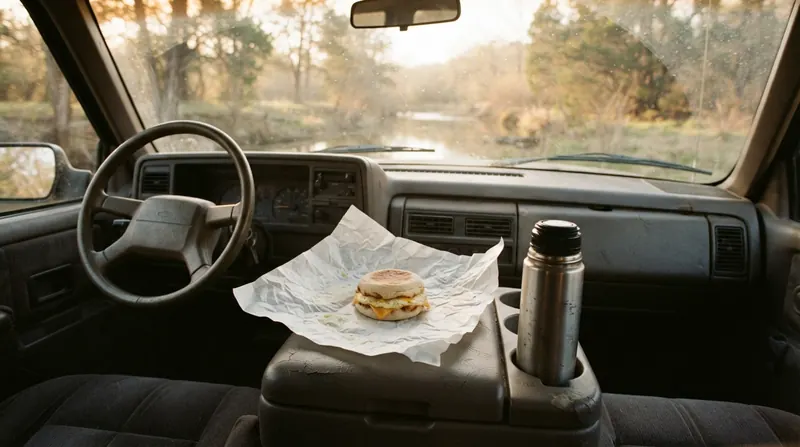
My breakfast most days is an egg sandwich from the gas station, eaten with the engine off at the pull-off.
The egg and the cheese bring some fat, and the pouch brings a little of its own.
How do you open it? You tear across the top and sip it straight from the corner.
It's ten milliliters, a little over two teaspoons, so it's gone in two or three sips.
What does it taste like? The panel lists raspberry and vanilla extracts, and the reviewers on the seller's page mostly talk about the raspberry.
I'll let their words describe it in a minute, because taste is the one thing a panel can't print.
Then the empty goes in the can behind the seat, and Tucker gets a biscuit from the jar in the door pocket.
That's the one part of the routine he's firmly in favor of.

Then the walk to the iron bridge and back, the drive into town, and the rest of the day the way it always goes.
The pouch took about thirty seconds of it.
Thirty seconds, no spoon, and an empty in the can. That's the whole routine.
How would you know if it's doing anything? Honestly, you may not.
The studies measured blood levels, not how anybody felt, and there's no blood test in a pouch.
What you can know in a month is simpler, and it's worth knowing.
Whether you like the taste, whether it sits well with your stomach, and whether the habit sticks.
How do I keep track without measuring anything? Here's the one habit I'd add.
Keep a glass jar on the kitchen windowsill and drop in a creek pebble each morning you take a pouch.
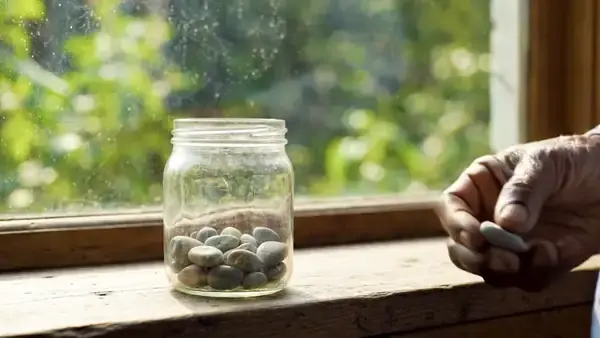
At the end of the month, count the pebbles.
If there are close to thirty, the habit stuck, and if there are twelve, you've learned something about the habit, not about CoQ10.
Should I change anything else that month? Keep everything else the same if you can.
Same coffee, same walk, same breakfast, so the only new thing in the morning is the pouch.
The Month, Week by Week
If you do decide to try a box, here's how I'd lay out the thirty days.
Four weeks, each with one small job.
Week one is about the habit. Take one pouch with breakfast, every day, and drop the pebble.
Don't judge anything yet; you're only finding out whether the habit fits your mornings.
Notice the taste, and notice how it sits with your stomach.
If anything doesn't agree with you, stop, and ask your pharmacist or your clinician.
Week two is about patience. A steady level in the blood takes one to two weeks of daily use to build. [10]
So this is the week you're still getting started, whatever you feel or don't.
It's also a good week to look at the other things you already do for your heart and circulation.
How many walks did you take, how much water did you drink, and how many times did you eat from the fryer?
Week three is about the rest of the morning. By now the pouch is routine, so pay attention to everything around it.
Did you walk more days than not, and did the dog get his biscuit instead of your empties?
Week four is about the decision. The seller's refund window is 30 days from the date of purchase, so this is the week to decide.
Not the week after, when the window has already closed.
And read the next section before you decide, because this seller's refund comes with a limit I haven't seen on many boxes.
It's the one thing I'd want every buyer to know before the first pouch.
Four weeks, a jar of pebbles, and a decision before the window closes.
The Refund, and the One-Time Rule
Here's a line I always read twice: the return terms.
They're the only part of a purchase that protects you if the rest doesn't work out.
What does Codeage promise? A 30-day refund, counted from the date of purchase.
That's the headline, and it's a reasonable one for a one-month box.
What's the catch? There are a few, and one of them is unusual.
Codeage allows one return per customer, for the whole time you're a customer, and it applies to your first order.
Read that slowly.
If you return a box, you can't return another one later, not next year and not on a different product.
What else? The return covers items bought at the regular price, not items bought on sale, in a promotion or as a gift.
Bundles can come back only if everything in them is unopened, and on a subscription, only the first order qualifies.
Codeage doesn't supply a return label, so the cost of mailing it back is yours.
Exchanges are only for a product that arrives damaged or defective.
One return, ever, on your first order, at the regular price. Write that on the box before you open it.
What does that mean for a first box? It means your first box is the one with a way back.
If you want to try it, try it on a first order, at the regular price, and decide inside the 30 days.
And the shipping? Shipping is at no charge on orders of $50 or more, before tax, in the 48 contiguous states.
One box at $39.99 doesn't reach that line by itself, so a single box ships at the seller's standard rate.
Alaska, Hawaii, Puerto Rico, military and post office box addresses may pay a surcharge.
Orders usually leave in one to two business days and take two to five more to arrive.
Is 30 days from purchase enough? It's tighter than it sounds.
With a few days to ship and a few more in transit, you'll have roughly three weeks of pouches inside the window, so write the purchase date on the box.
Who It Makes Sense For, and Who Should Skip It
Not every habit belongs in every morning.
Here's how I'd sort it, as plainly as I can.
It makes sense for a man who wants a daily CoQ10 and nothing to measure. One pouch, one tear, no spoon, no bottle in the refrigerator.
It makes sense for someone whose mornings happen away from the kitchen, in a truck, a shop or a tractor cab.
It makes sense for someone who likes a panel that prints the main ingredient on its own line, with its own number.
And it makes sense for a man who understands that the studies measured blood levels, and wants to try it on those terms anyway.
It doesn't make sense for a man counting on a pouch to do the work of the walk, the plate and the yearly visit.
Those are the habits with the long record behind them, and nothing in a pouch replaces them.
It doesn't make sense for anyone who takes something daily and hasn't asked the pharmacist first. [15]
And it doesn't make sense for anyone pregnant, nursing or under 18, by the box's own words.
It doesn't make sense for a household with a curious dog and no plan for the empties. [18]
And it doesn't make sense for someone allergic to sunflower seeds.
It doesn't make sense if you've already used your one Codeage return on something else and want a way back.
Then every box is a box you keep.
And it doesn't make sense for a man whose worry about his heart is real and growing.
That worry belongs with his own clinician, at a proper visit, not in a shirt pocket.
A pouch is a small daily choice. It works best when you see it as one.
Three Objections From the Feed Store Counter
When I told the fellows at the feed store about the pouch, they had objections, and good ones.
Here are the three I heard most, and my honest answers.

Objection one: "Forty dollars is a lot for thirty little bags." It might be, depending on your budget.
At $39.99 a box, it works out to about $1.33 a day, and whether that's a lot depends on what else that $1.33 would buy you.
If you're going to try it, try one box, not a subscription.
A month is enough to learn about the taste, the stomach and the habit, and it keeps that first order returnable.
Objection two: "It's made by a company I never heard of, down in Florida." Fair enough; I hadn't heard of them either.
What I can tell you is that they publish a street address, an 800 number, an email address and their hours, and that the panel prints the main ingredient's amount.
That's more than a lot of boxes on the same shelf give you.
It doesn't prove anything about what's inside, but it tells you there's someone to call.
Objection three: "A month can't tell you anything about your heart." You're right, and I'd rather say so than pretend.
A month tells you about the taste, the habit and your stomach, and it gets you past the week or two a steady blood level takes to build. [10]
It doesn't tell you what the pouch does for your heart and circulation, because no study has measured that for this pouch.
That's the honest limit, and it's the same limit for every CoQ10 product on the shelf.
Three objections, three honest answers. None of them needs settling today.
Four Questions I'd Put to the Company's Phone Line
A reading like this always ends with a few questions the box can't answer.
Here are the four I'd ask Codeage, at 1-800-870-4800, before a second box.
One: are the two 100-milligram lines the same CoQ10? The panel lists it on its own line and again inside the 3,000-milligram blend.
I read it as one amount, and a one-line answer from the company would settle it.
Two: how much xylitol is in a pouch? The panel names it and gives no amount.
It's the question a dog owner would ask first.
Three: why isn't xylitol in the ingredient list typed on the website? The photograph of the panel shows it, and the typed list leaves it out.
It's an easy correction, and it's worth asking for.
Four: how should the box be stored? The listing I read didn't say, and the box stays in the pantry at my house for that reason.
If the company says a cool, dry place, that's where it stays.
None of these questions is a trap.
They're the ordinary questions a careful buyer asks, and a company that publishes its phone number expects them.
A box that raises four fair questions and prints a number to call them in is a box you can read honestly.
What the Buyers Wrote
I always read the reviews last, after the panel, the studies and the return terms.
Reviews are the part of the reading written in other people's words.
How many reviews are there? When I read the seller's page, its review widget showed 28 reviews with an average of 5.0 stars, 27 of them at five stars and one at four.
The widget loaded eight of those reviews, and I read all eight.
Were the reviewers confirmed buyers? None of them carries a purchase mark in the seller's review system, so I don't give them one here.
One reviewer, Jeffrey A., is marked as having received a coupon, and his card below says so.
I left out the reviews that talked about their own health history or about other things they take.
Those are personal, and they aren't evidence about a pouch.
Here are three, word for word, with the gaps marked where I cut.
They're opinions, not evidence, and the small pictures beside them are illustrations, not the reviewers.

I wasn't sure what to expect with the Liposomal [CoQ10] pouches as far as taste goes. I was amazingly surprised by the raspberry flavor. … These pouches have clean ingredients and I would definitely purchase again.

This was easy to use, and it tastes good. I trust the brand … I only wish it cost less.
Paid testimonial. The reviewer was compensated for their review. Individual results may vary.

Raspberry flavor taste good. The pouches are good for travel or purse. They take up little space.
What do I take from them? All three talk about the taste and the pouch, and none of them promises anything about the body.
That's the right way to read a review of a daily supplement.
dljsatt was surprised by the raspberry, and Belinda likes that the pouches take up little space.
Jeffrey A. trusts the brand and wishes it cost less, which is about as honest as a five-star review gets.
Twenty-eight reviews averaging 5.0 is a small, very happy pile, collected by the seller's own widget.
I'd weigh it the way I weigh a few kind words at the feed store: pleasant to hear, and not a study.
The Whole Reading, on the Back of a Feed Receipt
If I had to fit the whole reading on the back of a receipt for Hal, here's what I'd write.
He'd read it in the truck, which is the only place he reads anything.
- Thirty 10 mL raspberry pouches, one a day, torn and sipped: nothing to measure.
- 100 mg of CoQ10 per pouch, against 3 to 6 mg a day from food. [6]
- Carried in a 3,000 mg sunflower-oil liposomal blend, with 3 g of fat and 54 calories.
- CoQ10 is best absorbed with fat, and less than 5 percent of a dose is thought to reach the blood. [9]
- The one liposomal study used capsules, in adults averaging 33, on an empty stomach, funded by its maker. [17]
- In older men, CoQ10 raised the blood level, not aerobic capacity. [13]
- Xylitol is on the printed panel and missing from the typed web list: keep the empties from the dog. [18]
- Pharmacist first if you take anything daily. [15]
- $39.99 a box, about $1.33 a day, and one box on its own falls short of the $50 shipping line.
- One return per customer, ever, within 30 days of the first order, at the regular price.
A box of thirty raspberry pouches, one torn open each morning
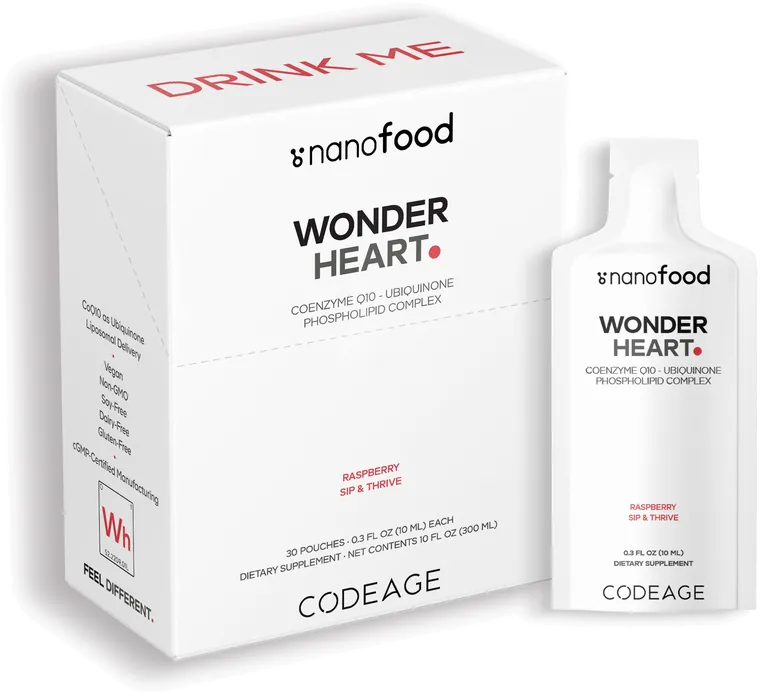
One raspberry pouch a day, torn open and sipped: 100 mg of CoQ10 carried in sunflower-oil liposomes, made in the USA by a Florida company.
CHECK AVAILABILITYSold by Codeage LLC, Boca Raton, Florida · 30 pouches of 10 mL, 100 mg of CoQ10 in each, one a day · refund within 30 days of purchase, one return per customer, first order only
What the Creek Trail Does That a Pouch Can't
Before I close, there's a page I add to every reading like this one.
It's the list of habits with the longest record behind them for the heart and circulation, and every one of them costs nothing.
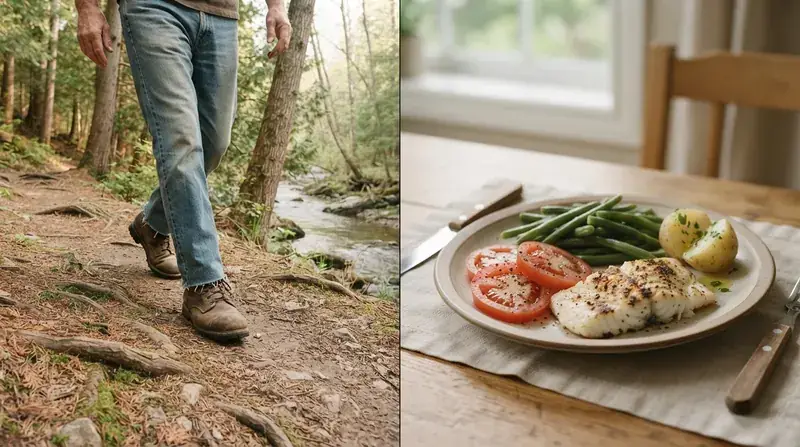
The walk. The federal guidelines ask adults for 150 to 300 minutes a week of moderate activity such as brisk walking, plus muscle-strengthening on two or more days. [1]
Bouts of any length count, even a few flights of stairs, and 10,000 steps a day is popular advice, not a guideline. [19]
How brisk is brisk? Fast enough that you can talk but not sing. [20]
In healthy adults aged 61 to 85, a pace of about 100 steps a minute marked the start of moderate intensity. [21]
For older adults, the guidelines add balance work, and they ask you to set your effort by your own fitness, not a stranger's. [22]
Healthy older adults average anywhere from 2,000 to 9,000 steps a day, so there's no single number to chase. [23]

The salt. Americans eat about 3,400 milligrams of sodium a day on average, against a limit of less than 2,300. [24]
Over 70 percent of it comes from packaged and prepared foods, so the label matters more than the shaker. [24]
On a label, 5 percent of the Daily Value or less per serving is low, and 20 percent or more is high. [24]
For what it's worth, the pouch's panel prints no sodium line.
The drinks. The Dietary Guidelines advise water and unsweetened drinks, and avoiding sodas, fruit drinks and energy drinks. [25]
They also advise drinking less alcohol for better overall health. [25]
The plate. The same guidelines set a goal of three servings of vegetables and two of fruit a day, and name olive oil, fish, nuts and seeds among sources of healthy fat. [26]
They also advise swapping deep-fried cooking for baked, broiled, roasted or grilled, and frying, as we saw, also costs food some of its CoQ10. [26] [8]
The cigarette. If you smoke, stopping helps at any age, however long you've smoked. [27]
Within a few days, the carbon monoxide level in the blood drops to that of someone who doesn't smoke. [27]
The yearly visit. Of the eight things the American Heart Association scores, four are daily habits and four are measurements of the body best checked with a clinician. [28]
No pouch, walk or article can take the place of that visit.
The cheapest habits have the longest records. The pouch is a small extra, not a substitute.
None of these replaces the pouch, and the pouch doesn't replace any of them.
They're different habits, and a good morning has room for all of them.
Back at the Pull-Off
I finished this reading on a Friday at the end of September, parked at the pull-off with the coffee going cold on the dash.
Tucker was asleep on the seat, and the creek was as low as it gets before the fall rains.

Here's where the reading landed.
The pouch is a daily CoQ10 with the amount printed plainly, carried in a little fat, in a package that asks you to measure nothing.
The evidence is honest but short.
CoQ10 is part of how every cell makes its energy, the heart holds a lot of it, and a daily supplement raises the level in the blood, but the trials in men didn't find a longer walk at the end of it. [4] [5] [13]
The package has its own small print.
Xylitol on the printed panel and not on the typed list, one return per customer, and a single box that ships below the line for shipping at no charge.
So is it worth forty dollars a box? For a man who'll actually take it, yes, it can be worth trying for a month, on a first order, with the dates written on the box.
For a man who wants a result on a stopwatch, no, and nothing on that shelf has shown one.
When I told Hal all of this at the tailgate the next morning, he listened to the whole thing.
Then he said, "So it's a month to find out, and the dog stays out of the trash," and I said that was about the size of it.
If you decide to try a box, you now know exactly what's in each pouch, where the evidence stops, and which four lines to write on the box.
If you decide not to, the walk, the plate and the yearly visit are still yours, and they cost less than any pouch.
Either way, I hope your mornings have a quiet stretch like my fifty minutes at the creek.
And I hope whatever rides along with you fits in a shirt pocket.

Questions from the pull-off
What kind of product is it?
A dietary supplement: a box of thirty 10 mL raspberry pouches with 100 mg of CoQ10 in each.
How many a day?
One pouch daily, by the label, and not more than that.
Do I need a spoon or a glass of water?
No. You tear the top and sip it from the pouch.
When should I take it?
The label doesn't say. CoQ10 is best absorbed with fat in a meal, so breakfast is a sensible habit. [9]
Does it have sugar?
The panel lists 0 g of sugars, 5 g of carbohydrate and 54 calories. It's sweetened with glycerin and xylitol.
What about my dog?
No. Xylitol is on the printed panel, so keep the box and the empties where a dog can't reach them. [18]
How long before the level in my blood is steady?
About one to two weeks of daily use. [10]
Has this pouch been tested in a study?
Not that we could find. The studies on this page tested CoQ10 in other forms and other people.
How does the refund work?
Thirty days from purchase, one return per customer ever, on the first order, at the regular price.
Should I talk to anyone first?
Your pharmacist, if you take anything daily. [15]
Sold and shipped by Codeage LLC, Boca Raton, Florida. The price, shipping and any subscription discount are set by the seller.
Every line of the panel, what each ingredient is and what the studies behind CoQ10 measured are written out in the ingredient and advertising guide linked at the foot of this page.
The guide also explains the xylitol line, the refund terms and the question worth asking your pharmacist.